Three parts of your car wear out quietly. The timing belt, the brake pads and the coolant all have a service life, and none of them gives much warning before the end of it. In a subtropical climate like the Tweed Coast, heat and humidity shorten that life further. Here is how to know when each one is due.
The short version
- Most timing belt manufacturers recommend replacement between 60,000 and 100,000 km, or every 5 to 7 years, whichever comes first.
- On an interference engine, a broken timing belt can bend valves and damage pistons. The repair bill dwarfs the cost of a scheduled replacement.
- Brake pad life ranges from 30,000 to 70,000 km depending on driving conditions. Stop-start suburban driving wears pads faster than highway cruising.
- Conventional coolant should be replaced every 2 years or 40,000 km. Long-life coolant lasts up to 5 years or 150,000 km.
- The Bureau of Meteorology records a mean annual temperature around 20 degrees C for the Tweed and Coolangatta area, with summer means above 25 degrees C. Heat accelerates rubber and coolant breakdown.
What a timing belt does
The timing belt is a reinforced rubber belt with teeth on the inside face. It connects the crankshaft to the camshaft and keeps the two turning in exact synchronisation. The crankshaft drives the pistons up and down. The camshaft opens and closes the valves that let fuel and air in and exhaust gases out. If the belt slips or breaks, those two actions lose their coordination and the engine stops immediately.
Not every car uses a belt. Some engines use a timing chain, which is a metal chain running in oil. Chains generally last longer than belts and do not have the same replacement interval. Your service manual or logbook will tell you which your car has.
What happens when a timing belt breaks
Interference engines
Most modern engines are interference designs. In an interference engine, the valves and pistons occupy the same space in the cylinder at different points in the rotation cycle. The timing belt is the only thing keeping them apart. When the belt breaks, the crankshaft keeps spinning under momentum while the camshaft stops. Pistons slam into open valves. The result is bent valves at a minimum, and often damaged pistons, cylinder head scoring and broken camshaft lobes.
That kind of damage can turn a replacement that would have cost a few hundred dollars into major engine repairs running into the thousands.
Non-interference engines
A non-interference engine has enough clearance between valves and pistons that a belt failure does not cause them to collide. The engine still stops and the car will not run until the belt is replaced, but the internal parts survive. These engines are less common in newer vehicles. If your car has one, a belt failure is still an inconvenience and a tow, but it is not catastrophic.
Either way, a belt that breaks on the Pacific Motorway or the Tweed Valley Way leaves you stopped in traffic, which is a safety problem whether the engine survives or not.
When to replace the timing belt
Most timing belt manufacturers recommend replacement between 60,000 and 100,000 km, or every 5 to 7 years, whichever comes first. The interval varies by engine. The correct figure is in the manufacturer's service schedule for your specific engine.
The "whichever comes first" part matters in the Tweed. A car that does short local trips around Tweed Heads or Banora Point may take 7 years to reach 60,000 km. The belt still needs replacing at that point. Rubber degrades with age, heat and humidity regardless of how far the car has travelled.
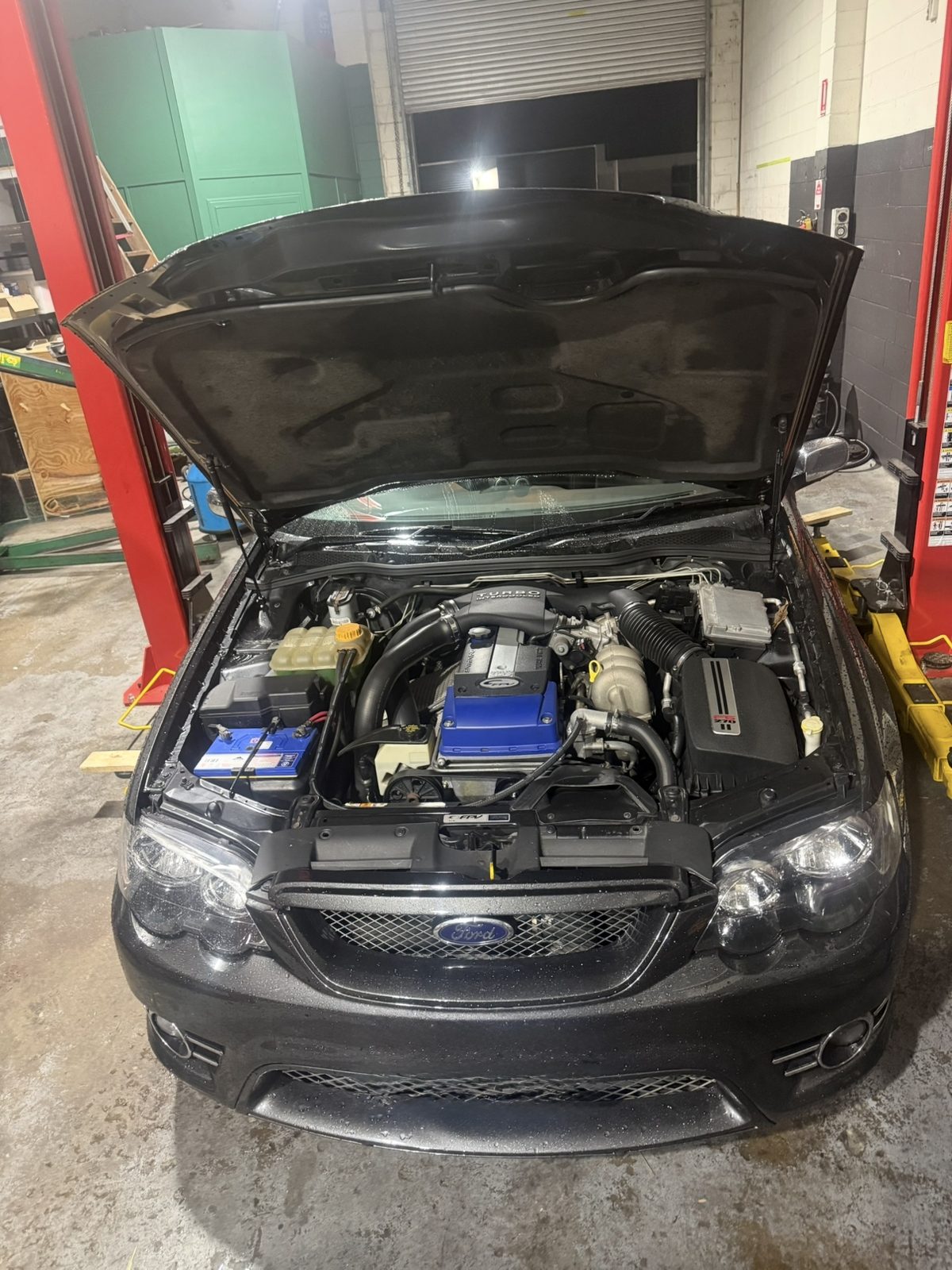
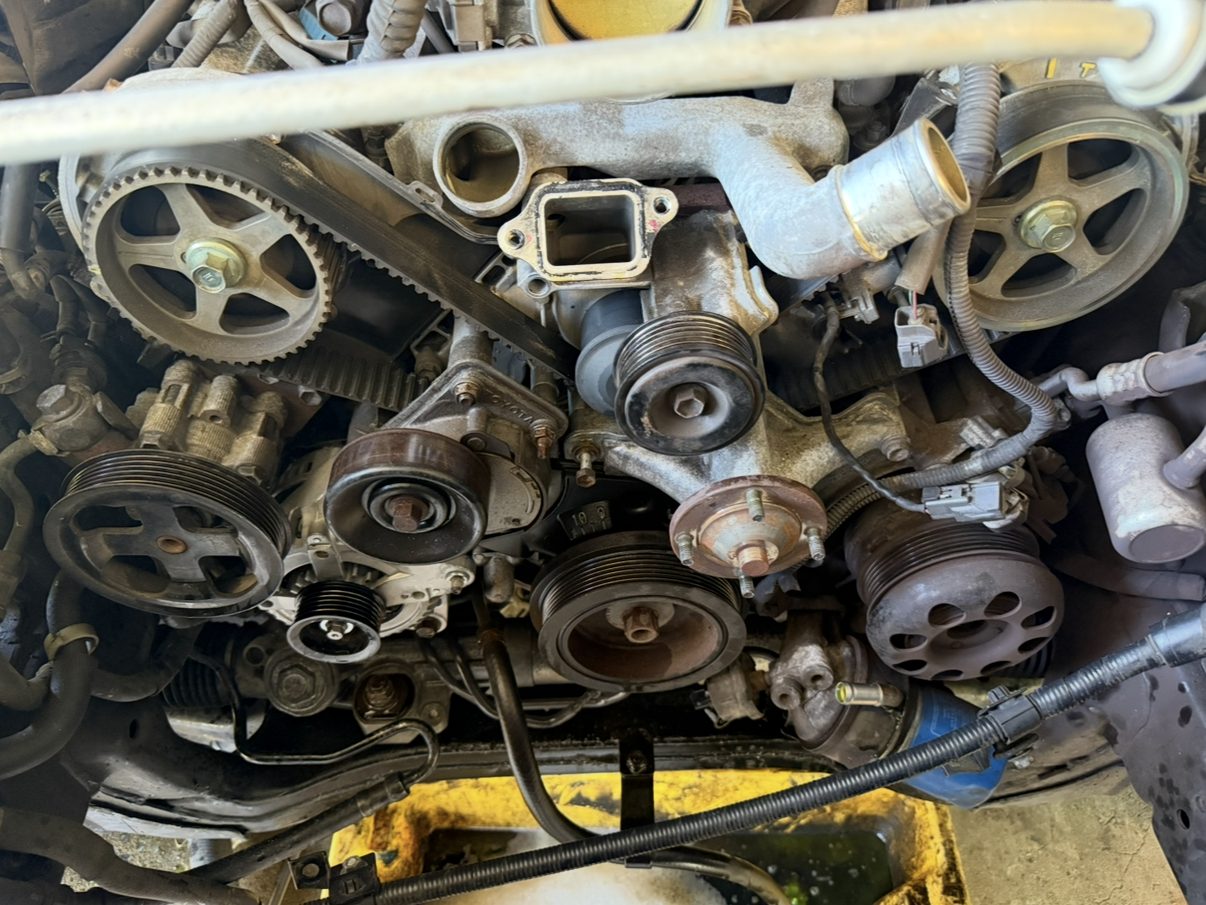
When the belt is replaced, the water pump, tensioner and idler pulleys are normally done at the same time. They sit behind the same covers, they wear at a similar rate, and the labour to reach them is the same labour you are already paying for.
Brake pads and rotors
Brake pads are the consumable part of the braking system. They press against a spinning metal rotor to slow the wheel. Every time you brake, a thin layer of pad material wears away. Eventually the friction material gets too thin to work safely.
Brake pad life ranges from 30,000 to 70,000 km depending on the vehicle, the pad compound and how the car is driven. The rotors last longer but not forever. A brake inspection checks both.
Signs the pads are getting low
A high-pitched squeal when braking is the most common early warning. Most pads have a small metal wear indicator tab. When the friction material wears down far enough, the tab contacts the rotor and produces that squeal.
If the squeal turns into a grinding noise, the pad material is gone and the metal backing plate is pressing directly against the rotor. At that point you are replacing rotors as well. Catching it at the squeal stage saves the rotors.
Other signs include the brake pedal feeling softer, the car pulling to one side under braking, or a pulsation through the pedal.
What affects brake pad life on the Tweed Coast
Stop-start driving through roundabouts and traffic lights in Tweed Heads and along Minjungbal Drive uses the brakes constantly. A car in that traffic wears pads faster than one doing long runs on the M1.
Hills matter too. Driving down from the hinterland through Terranora or the Bilambil hills loads the brakes on every descent.
Salt air does not wear pads, but it corrodes rotors and caliper hardware. Calipers with corroded slide pins can seize, causing one pad to drag permanently. That pad wears out quickly, and it pulls the car under braking.
Why coolant matters more in subtropical heat
Engine coolant carries heat away from the engine block and prevents corrosion inside the cooling system. The corrosion inhibitors in the fluid break down over time. When they do, the coolant becomes acidic and attacks the aluminium in the radiator, heater core and water pump housing from the inside.
Heat speeds up that breakdown. An engine running in 30 degree C ambient temperatures is working harder than one in 15 degree weather. The coolant runs hotter, the inhibitors deplete faster and the replacement interval becomes real rather than theoretical. Cooling system repairs catch this by checking coolant condition at each service.
Coolant types and intervals
Conventional coolant uses inorganic acid technology inhibitors. These coat every internal surface of the cooling system and deplete steadily. The replacement interval is every 2 years or 40,000 km, whichever comes first. Long-life coolant uses organic acid technology inhibitors, which target only the spots where corrosion is starting. They last longer as a result, with a typical interval of 5 years or 150,000 km.
The two types should not be mixed. Different inhibitor chemistries can react and form a gel that blocks passages in the radiator and heater core. Engine coolant and antifreeze products sold in Australia are covered by Australian Standard AS 2108, which sets requirements for composition, performance and labelling. Using a coolant that meets the standard and matches the manufacturer's specification for your vehicle is the baseline.
If you do not know what is in your cooling system, a diagnostic check can identify it. A full flush removes the old fluid entirely before fresh coolant goes in, which is the only way to be sure the inhibitors are starting from full strength.
How local driving conditions change the numbers
Short trips are harder on all three components. An engine that never fully warms up runs richer, produces more condensation and puts the belt under thermal cycling stress. A car used mostly for school runs and shopping trips around Tweed Heads accumulates wear faster per kilometre than one doing the same distance on the motorway.
Humidity accelerates rubber deterioration. A timing belt in an engine bay that never fully dries out ages differently to one in a dry inland climate. The same goes for brake hoses and coolant hoses. A visual inspection during a scheduled service catches cracking and swelling before a hose fails on the road.
Dust from unsealed roads, which you will find in parts of Bilambil and the rural edges of the Tweed Valley, gets into brake components and increases pad and rotor wear. If you regularly drive on gravel or unsealed surfaces, the lower end of the pad life range is the one to plan for.
Where to start
If you are not sure when your timing belt was last done, or whether your brake pads or coolant are due, the simplest step is to book a check. We can look up the manufacturer's service schedule for your specific engine, measure the brake pad thickness, test the coolant condition and tell you exactly where each one sits.
Valley View Automotive is in Tweed Heads South, NSW 2486, servicing vehicles from across the Tweed. A timing belt that is on schedule is a quiet, routine job. One that has been forgotten is an emergency. The same goes for brake pads and coolant. Get in touch and we will let you know where yours stand.